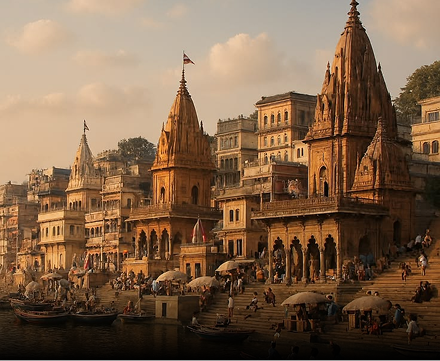
THE LANDSCAPE OF TIME
A living sacred city where worship, learning, trade, death and liberation continue beside the Ganga.
What does it mean for a sacred city to remain alive across centuries?

Come for darshan. Travel deeper.
An eight-day historian-led yatra through Kashi, Ayodhya and Braj bringing together sacred geography, history, archaeology, philosophy and living tradition.
An enquiry, notification or waitlist request does not hold a place. A booking is confirmed only through the applicable booking and payment process.
THE JOURNEY AND THREE LANDSCAPES
Kashi, Ayodhya and Braj are among the most meaningful sacred landscapes of Bharat. Millions visit them for darshan. Far fewer receive the time, context and continuity needed to understand how their temples, ghats, streets, texts, traditions and memories belong together.
Over eight thoughtfully designed days, the journey moves from Shiva's Kashi to Rama's Ayodhya and onward to Krishna's Braj. Agra forms an architectural and historical epilogue before the journey concludes in Delhi.
A living sacred city where worship, learning, trade, death and liberation continue beside the Ganga.
What does it mean for a sacred city to remain alive across centuries?
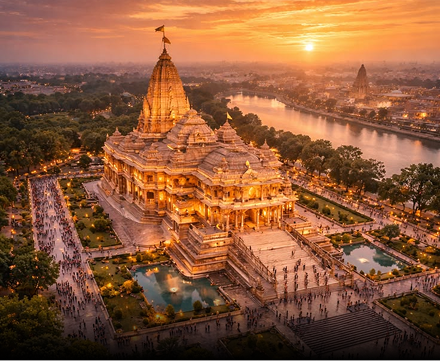
A landscape of Rama, exile and homecoming, personal sacrifice, public duty and the responsibilities of power.
Why does Rama continue to shape ideas of duty, leadership and belonging?
.png)
Mathura, Vrindavan, Govardhan, Radha Kund, Barsana and Nandgaon form a sacred geography carried through poetry, pilgrimage, music and memory.
How does landscape enter a civilisation's emotional and spiritual world?
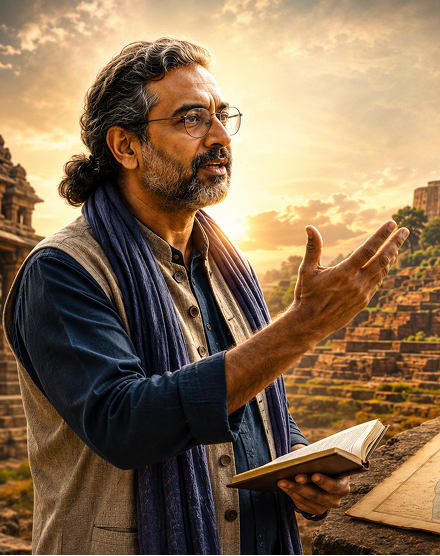
Chandru Ramesh is a historian, author, filmmaker, heritage researcher and Chief Experience Officer of Bhumivox. He is the author of Mahabharata: Myth or History? and the filmmaker behind Science in Ancient India.
His role is not to recite dates or force every tradition into a historical claim. He helps travellers distinguish what texts say, what archaeology and material evidence indicate, what communities preserve as living tradition, what later history added, and what remains debated or unanswered.
Approach sacred sites respectfully while also understanding historical, architectural and civilisational contexts.
Rivers, ghats, routes, neighbourhoods, hills and communities are part of the story.
The order has meaning. Each landscape prepares the traveller to see the next more deeply.
Approach sacred sites respectfully while also understanding historical, architectural and civilisational contexts.
Rivers, ghats, routes, neighbourhoods, hills and communities are part of the story.
The order has meaning. Each landscape prepares the traveller to see the next more deeply.
The route moves deliberately from Kashi to Ayodhya to Braj, with Agra as an architectural and historical epilogue and Delhi as the closing point.
Arrival in Varanasi. Welcome gathering and introductory briefing with Chandru Ramesh introducing the civilisational antiquity and spatial cosmology of Kashi.
Early morning darshan at Kashi Vishwanath temple complex and exploring the sacred lanes of old Varanasi.
Scenic drive to Ayodhya. Orientation on the Valmiki Ramayana, epigraphic records, and the multi-layered history of the Sarayu river valley.
Journey from the solemn moral world of Ayodhya to the lyrical devotional realm of Brajbhoomi.
Exploration of ancient Mathura—one of India's earliest artistic and urban capitals—and the historic temples of Vrindavan.
Full day immersed in the pastoral and sacred geography of the wider Braj Mandala.
Morning drive to Agra. An architectural and historical epilogue examining how medieval imperial powers interacted with the Yamuna heartland.
Final morning closing circle and symposium with Chandru Ramesh consolidating the themes of sacred geography, memory, and heritage preservation.
Timings and access may change due to temples, festivals, weather, security, regulations and local conditions.
No academic background is required. Curiosity and respect matter more than prior knowledge.
For travellers who want to understand Bharat beyond the usual sightseeing circuit and introduce family members to its sacred landscapes.
For those seeking a deeper connection with places, traditions and civilisational memory.
For curious travellers seeking a serious but welcoming introduction to Indian civilisation.
Expect early mornings, steps, ghats, uneven lanes and several periods of walking. No site visit is compulsory, but local accessibility varies.
This is not a luxury retreat, an academic conference or a priest-led ritual package. It is a carefully organised heritage yatra combining experience, interpretation and reflection.
Departure information must come from the live Departure record. Do not hard-code sample dates, prices, leader names or seat counts.
Booking Open / Few Places → Book or Reserve only when direct booking works. Enquiry → Check Availability. Coming Soon → Notify Me. Waitlist → Join Waitlist. Sold Out → Ask About Another Date.
An enquiry, notification or waitlist request does not hold a place. A booking is confirmed only through the applicable booking and payment process. No countdown timers or invented scarcity.
Clear scope, transparent inclusions and practical answers.
Seven nights in the stated hotel category; scheduled vegetarian meals; AC ground transport; group transfers in designated windows; intended historian/leader; required local guides; specifically listed tickets and experiences; Varanasi boat; talks and dossier; on-ground coordination; taxes stated in the quotation.
Travel to Varanasi and onward from Delhi; visas; insurance; personal expenses; gratuities; donations, pujas or special darshan; optional activities, upgrades or extensions; full Govardhan Parikrama unless listed; separate photography charges; anything not expressly included.
Scheduled meals arranged by Bhumivox contain no meat, fish or eggs. Jain and no-onion/no-garlic requests should be made at least 14 days in advance and remain subject to supplier confirmation. Severe allergies require a pre-booking conversation.
Comfortable three- to four-star-category hotels selected for cleanliness, location, service and route access. Proposed hotels and room category are shared with the written quotation. Upgrades are subject to availability and extra cost.
It brings both together. Darshan and sacred spaces are approached with full reverence and traditional protocols, while the historical, textual, archaeological and philosophical layers of each site are explored in depth.
Yes, flagged departures with Chandru Ramesh's name are led by him directly from start to finish. In the rare event of unforeseen circumstances, an experienced scholar-historian from the research ecosystem steps in with advance notification.
The journey is rated Moderate. It involves walking through temple complexes, ghat steps, and historic urban lanes. We travel at a steady, unhurried pace, and electric carts or battery rickshaws are utilized where locally available.
Senior citizens in reasonable health are warmly welcome. Flights to Varanasi and out of Delhi are not included to allow flexible routing. Because the narrative unfolds sequentially across all eight days, partial participation is generally not recommended.
The standard itinerary covers key sacred sites of the Govardhan circuit (Radha Kund, Shyama Kund, Mansi Ganga, Kusum Sarovar). A full 21 km walking parikrama can be arranged as a pre-trip or post-trip customized extension.
If local administration, security protocols or festivals close an area unexpectedly, our on-ground team activates alternative sacred sites and historical landmarks that maintain the thematic continuity of the yatra.
Complete cancellation policies, payment milestones, refund schedules, and travel terms are available on our Terms of Use page and are provided in full detail with your formal quotation.
You may arrive knowing the names: Rama. Krishna. Shiva. You should leave seeing how their stories, landscapes, philosophies and living traditions belong to a much larger civilisational conversation.